RTV Materials Knowledge
What Is Antimony Ingot? Uses, Grades and Purchasing Checks
Understand antimony ore, concentrate and ingots, explore 10 downstream product groups and 12 applications, and check grades, batch reports and warehouse handover.
From ore to industrial feedstock, antimony enters products as varied as cables, batteries, solar cover glass, industrial bearings and infrared detectors. Understanding its different forms helps buyers specify the intended use, quality requirements and delivery conditions.
Antimony ingot is an industrial feedstock consisting mainly of antimony (Sb), produced through smelting, refining and casting. It can be used to make antimony compounds and alloys. Ingots, concentrates and antimony trioxide differ in composition, form and use: an inquiry should identify the actual product, rather than simply request “antimony”.
Illustration notice: All eight images are AI-generated educational illustrations. They do not show RTV inventory, production facilities or customer projects. Appearance cannot establish chemical identity, purity or quality.
1. Antimony: metallic appearance, brittle properties
Antimony has the symbol Sb and atomic number 51 and is generally classified as a metalloid. Its metallic form is silvery, hard and brittle. These properties help describe the material; colour or fracture appearance cannot determine whether a shipment meets its specification. Royal Society of Chemistry: antimony
Purchasing documents should state the full product name and form. “Antimony Ingot” and “Antimony Trioxide” refer to different products, requiring their own testing and acceptance criteria.
2. Ore, concentrate and ingots: what is the difference?
Stibnite, principally Sb₂S₃, is an important antimony mineral. Commercial ore contains other minerals too, so a mineral's chemical formula must not be treated as the antimony assay of a whole cargo. NTP monograph, page 17
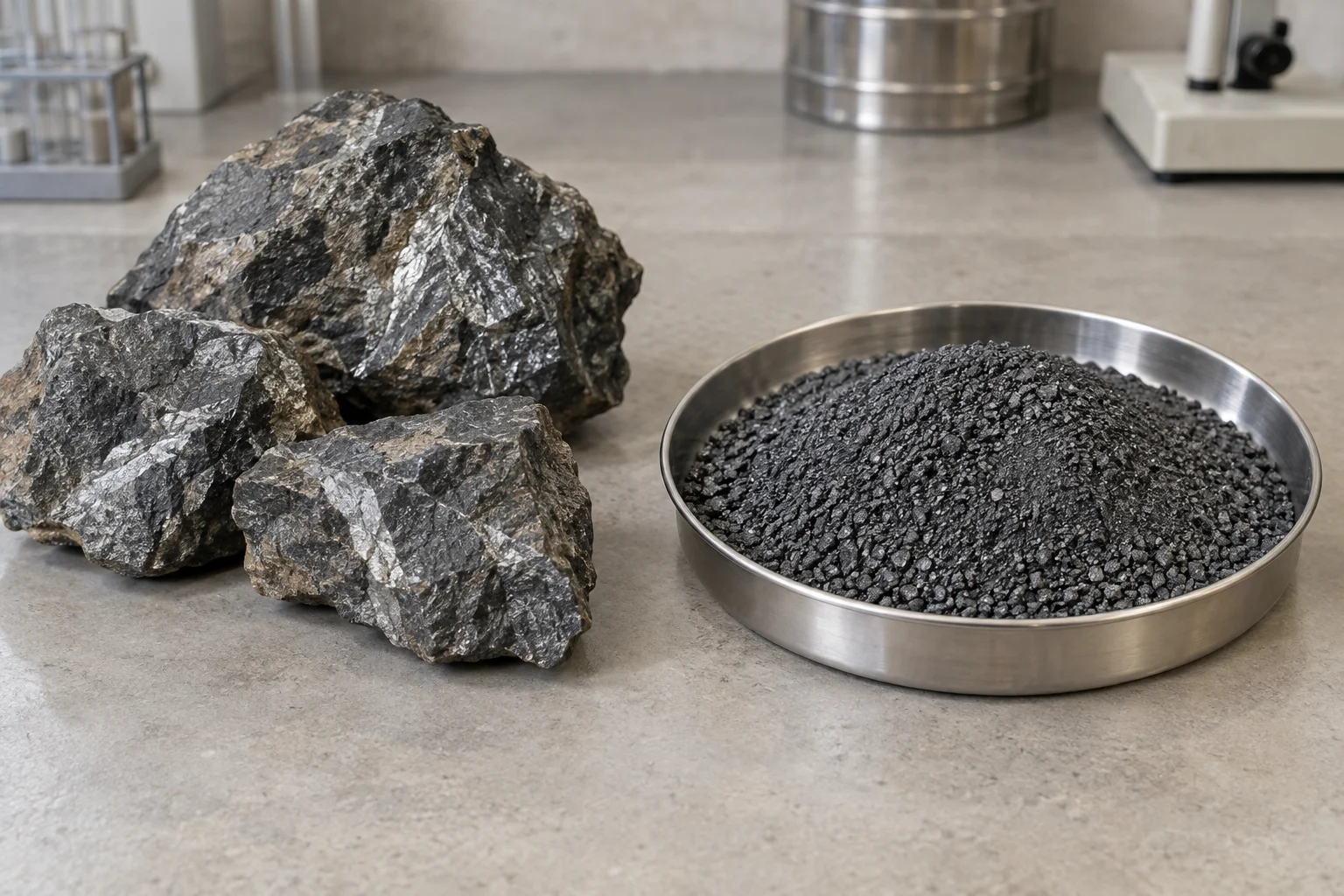
| Product | Supply-chain stage and form | Purchasing checks |
|---|---|---|
| Antimony ore | Mine feedstock containing antimony-bearing and other minerals | Sb assay, associated elements, representative sampling, moisture and weighing basis |
| Antimony concentrate | Beneficiated feedstock, commonly powder or fine particles | Dry-basis assay, moisture, impurities and smelter acceptance conditions |
| Antimony ingot | Metallic antimony refined and cast into ingots | Grade, measured Sb and impurities, heat numbers and batch correspondence |
| Antimony trioxide | Sb₂O₃, generally a white powder | Product content, impurities, particle size and application-specific requirements |
These are inquiry and verification topics, not a universal acceptance standard. A price per tonne is not directly comparable across ore, concentrate and ingot without clarifying payable content, measurement basis, deductions and delivery terms.
3. From mineral feedstock to downstream materials
A representative metallic-antimony supply chain is:
Ore or concentrate → smelting and refining → antimony ingots → antimony compounds or alloys → industrial applications
This illustrates the division of work, not the only process route. Not every antimony product must first become an ingot: antimony trioxide can also be processed from crude oxide. Feedstock and target product determine the route. NTP, pages 17–18
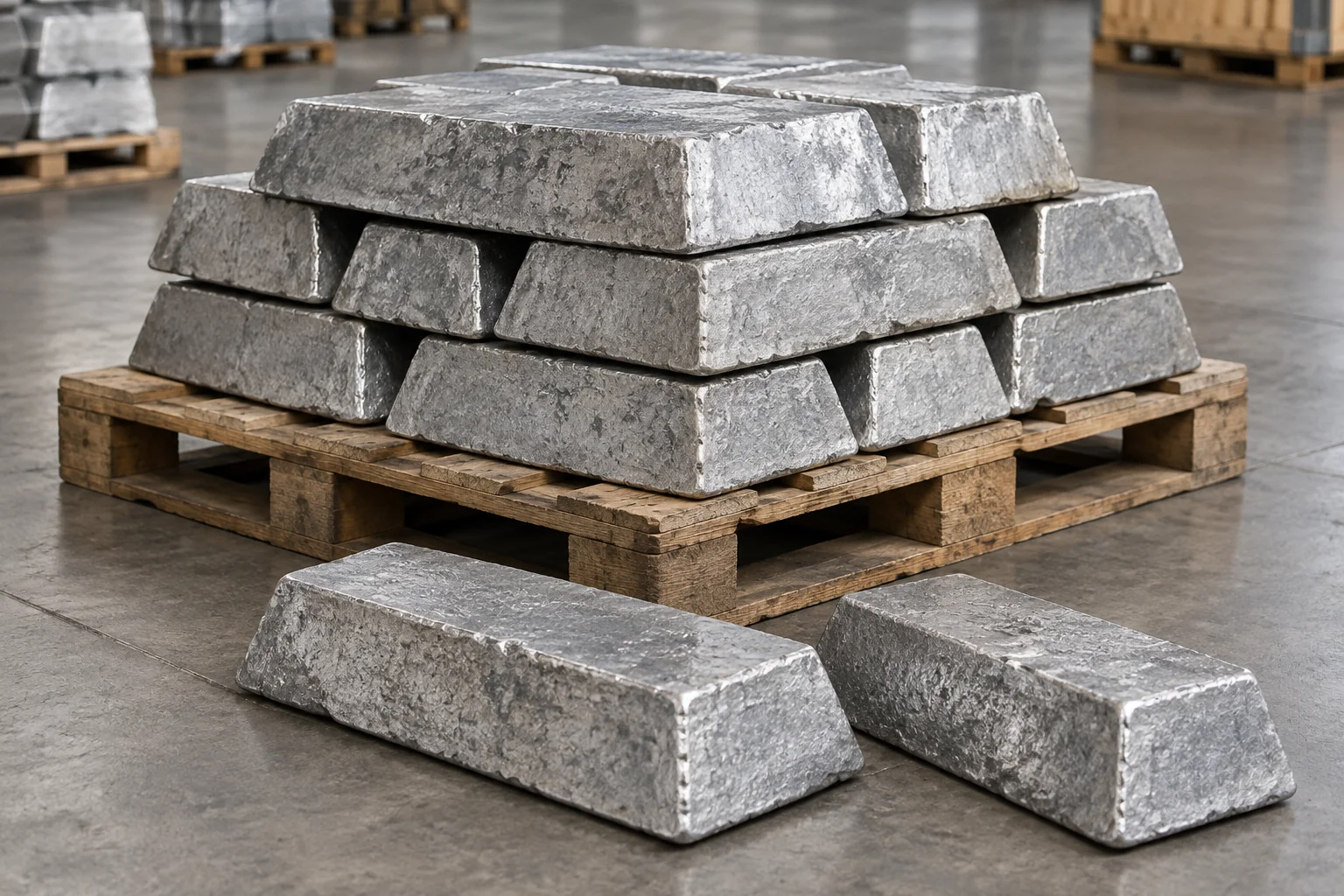
Ingot buyers may manufacture antimony chemicals or alloys, or trade metals. Buyers requesting the same reference grade can still have different impurity limits, sampling requirements and packaging needs. Explaining the intended use helps suppliers prepare a relevant quotation.
4. Ten downstream product groups
Downstream processing changes more than packaging. Oxides, sulfides, alloys and semiconductors have different compositions and functions; powders, dispersions and masterbatches also impose different processing requirements. The following 10 groups cover traded products and processed forms, not ten mutually exclusive chemical substances.
Chemical products and formulated materials
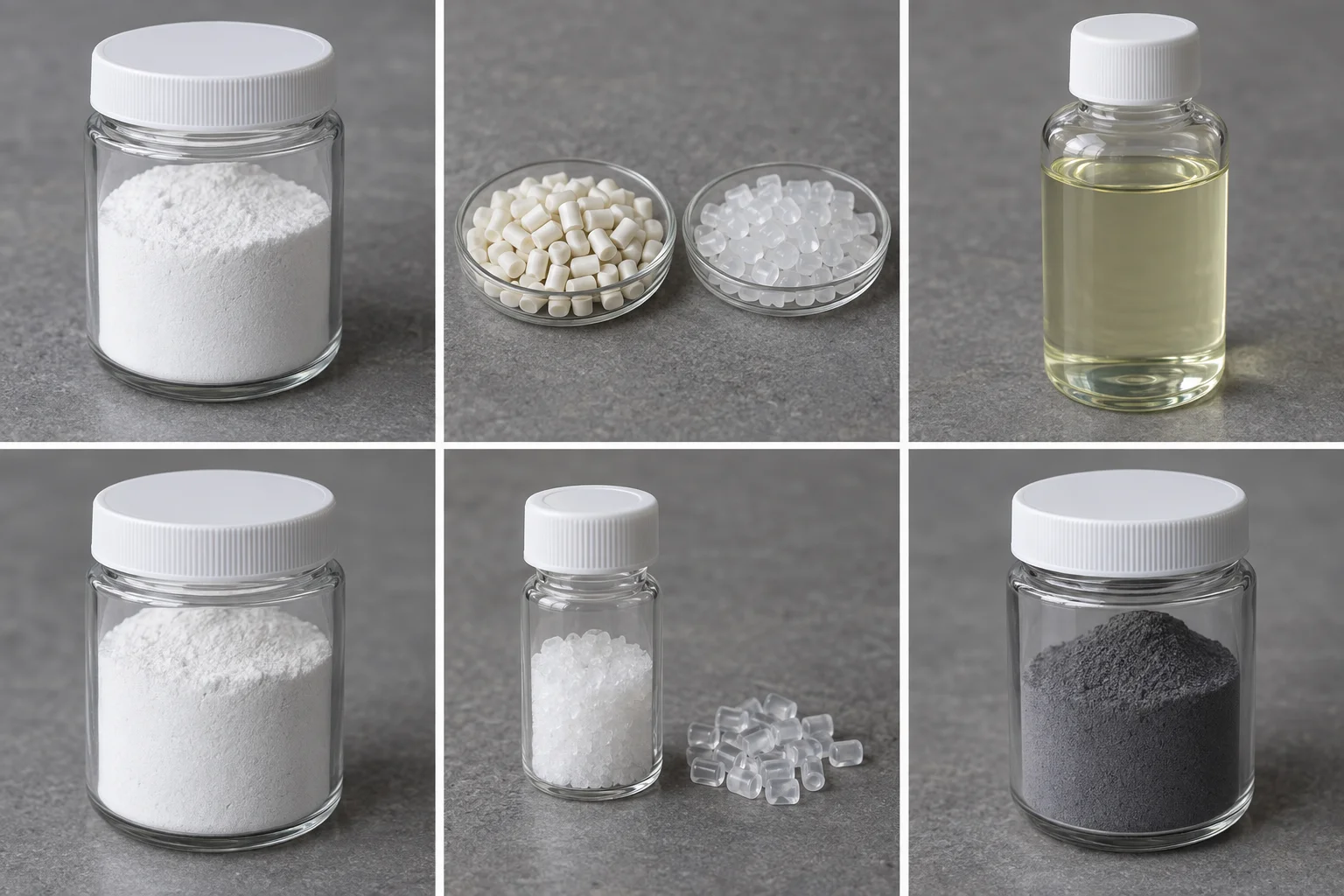
| Downstream product | Form and function | Further processing or use |
|---|---|---|
| ① Antimony trioxide / Sb₂O₃ | Usually a white powder; a synergist in selected halogenated flame-retardant systems | Plastics, rubber and textile-coating formulations; selected grades for catalysts or pigment feedstock |
| ② Antimony-containing masterbatches, wetted powders and dispersions | Compounds formulated with a carrier to change handling and dispersion | Plastics compounding, rubber mixing and coating; carrier or resin compatibility matters |
| ③ Antimony pentoxide / Sb₂O₅ | Available as colloidal dispersions, powders and resin dispersions | Selected flame-retardant epoxy, unsaturated-polyester and vinyl-ester systems |
| ④ Sodium antimonate | Industrial antimony compound; identify composition and grade from the product documentation | Selected engineering-plastic flame-retardant formulations and glass-fining systems |
| ⑤ Antimony-based polyester catalysts | Including antimony glycolate and catalyst-grade antimony trioxide | PET polymerization followed by bottle, film or fibre production |
| ⑥ Antimony trisulfide / Sb₂S₃ | Industrial sulfide powder for suitable friction formulations | Selected automotive brake pads and brake shoes |
Sources for ①②: Campine product forms and Nihon Seiko applications; ③: NYACOL pentoxide products; ④: NYACOL glass-fining applications; ⑤: antimony glycolate product information and Nihon Seiko polyester catalysis; ⑥: Nihon Seiko trisulfide information.
Specification discussions should go beyond antimony content. Check active content and carrier for masterbatches, solids content and compatibility for dispersions, process suitability for catalysts, and formulation-specific particle-size requirements for friction additives. These are inquiry topics; the user of the material should define the actual acceptance limits.
Alloys, functional oxides and semiconductor materials
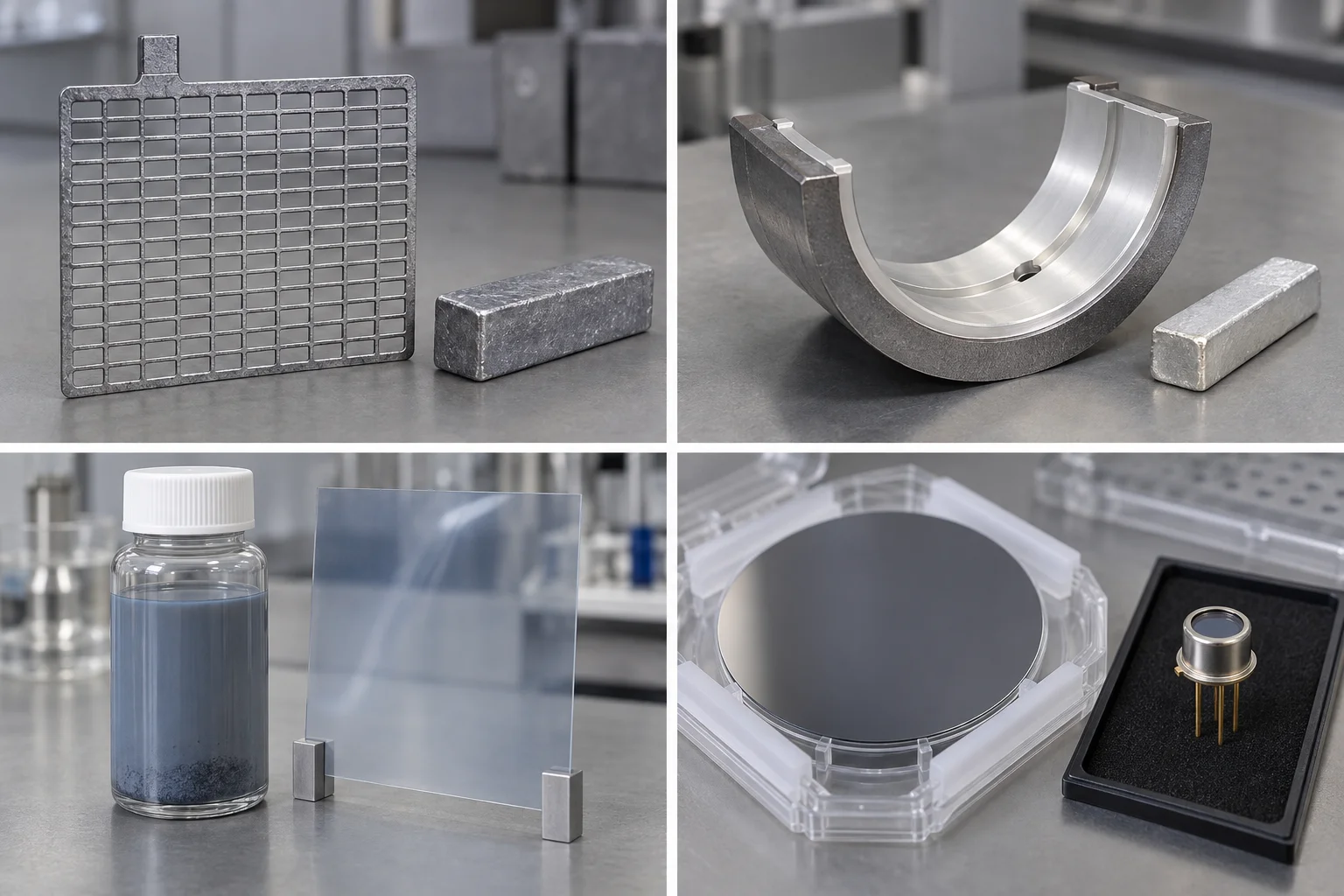
| Downstream product | Role of antimony | Representative use |
|---|---|---|
| ⑦ Lead-antimony alloys | Alloy constituent that improves hardness and strength | Selected lead-acid battery grids and other suitable lead-alloy components |
| ⑧ Tin-antimony-copper and other babbitt alloys | Constituent of bearing white metal | Linings and shells of suitable industrial plain bearings; not a generic term for rolling-bearing steel |
| ⑨ Antimony-doped tin oxide | Functional doped oxide, supplied as powders or dispersions | Antistatic coatings and infrared-absorbing films or coatings |
| ⑩ Antimonide semiconductor materials | Compound-semiconductor systems such as InSb and InAsSb | Selected infrared detectors and spectroscopy instruments, with dedicated material and device processes |
Sources: Royal Society of Chemistry, Waukesha bearing materials, NYACOL doped tin oxide and Hamamatsu FT-NIR / FT-IR detectors.
“ATO” can refer to different materials. In flame retardants it commonly means Antimony Trioxide; in functional coatings it can mean Antimony-doped Tin Oxide. State the full name, composition and use when making an inquiry.
Semiconductor applications require dedicated controls for purity, impurities, crystal growth and device performance. An ordinary industrial ingot grade is not a semiconductor-grade specification, and does not establish that a particular lot is suitable for chip or infrared-device production.
5. Twelve application areas
Connect the final product, the antimony-containing material and its function in the process. These examples cover established industrial uses and specialist material systems. Alternative technologies exist, and not every product in a listed category contains antimony.
A. Electrical parts, textiles and rubber
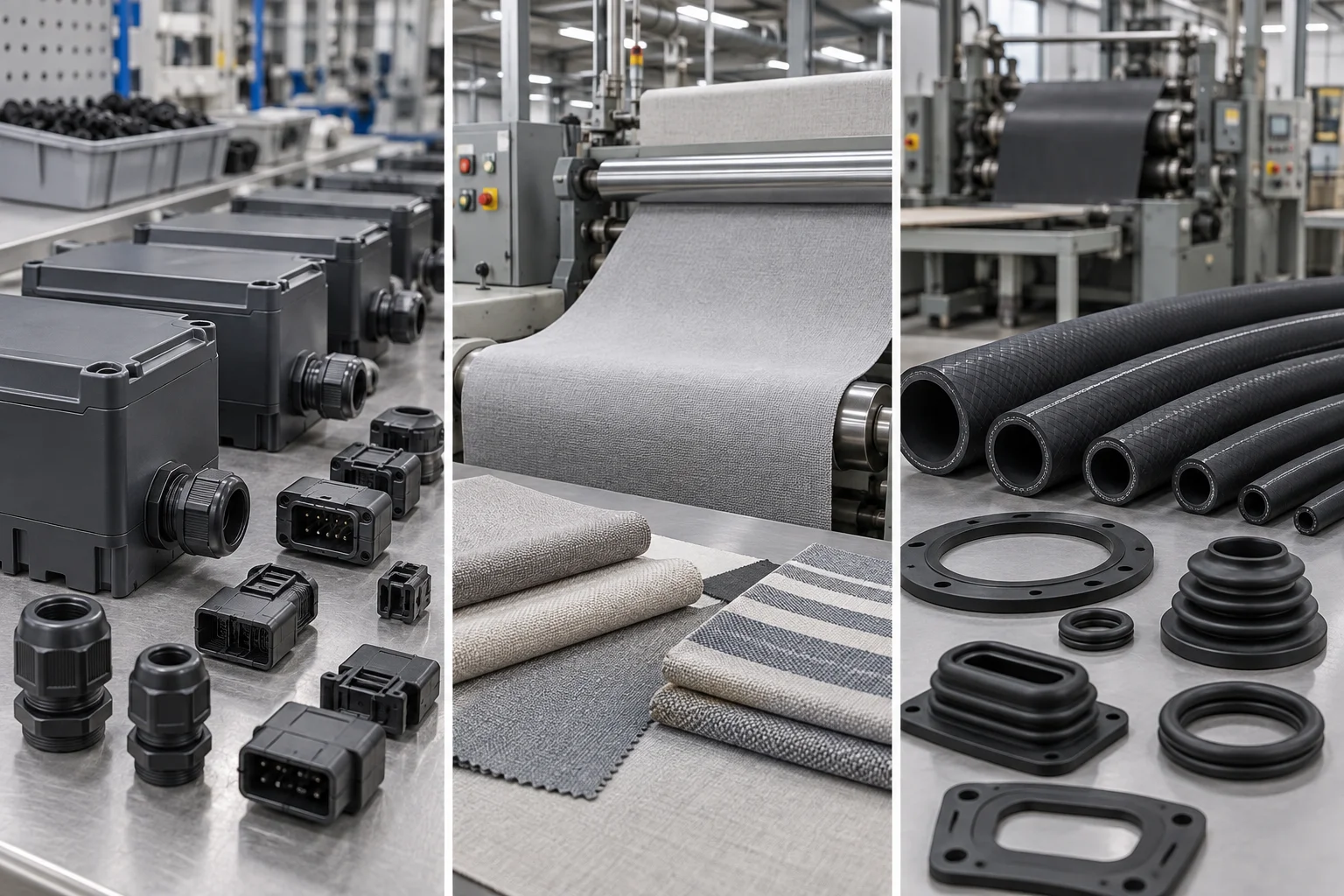
| Application | Material and role | Purchasing considerations |
|---|---|---|
| 01 Electrical housings and connectors | Selected plastic formulations use antimony trioxide, sodium antimonate or related formulated products for flame-retardant synergy | Resin type, dispersion, colour and target fire testing |
| 02 Awnings, tent canvas and upholstery | Selected textile coatings or finishing systems use antimony-containing flame-retardant products | Coating system, processing method, durability and finished-product requirements |
| 03 Rubber hoses, protective parts and suitable interior materials | Antimony-containing additives or masterbatches in compatible flame-retardant formulations | Rubber compatibility, mixing dispersion and effects on physical properties |
See Campine textile and plastic examples, Nihon Seiko applications and sodium antimonate use. Purchasing considerations are an editorial discussion checklist, not a substitute for formulation testing.
B. Solar cover glass, ceramics and polyester
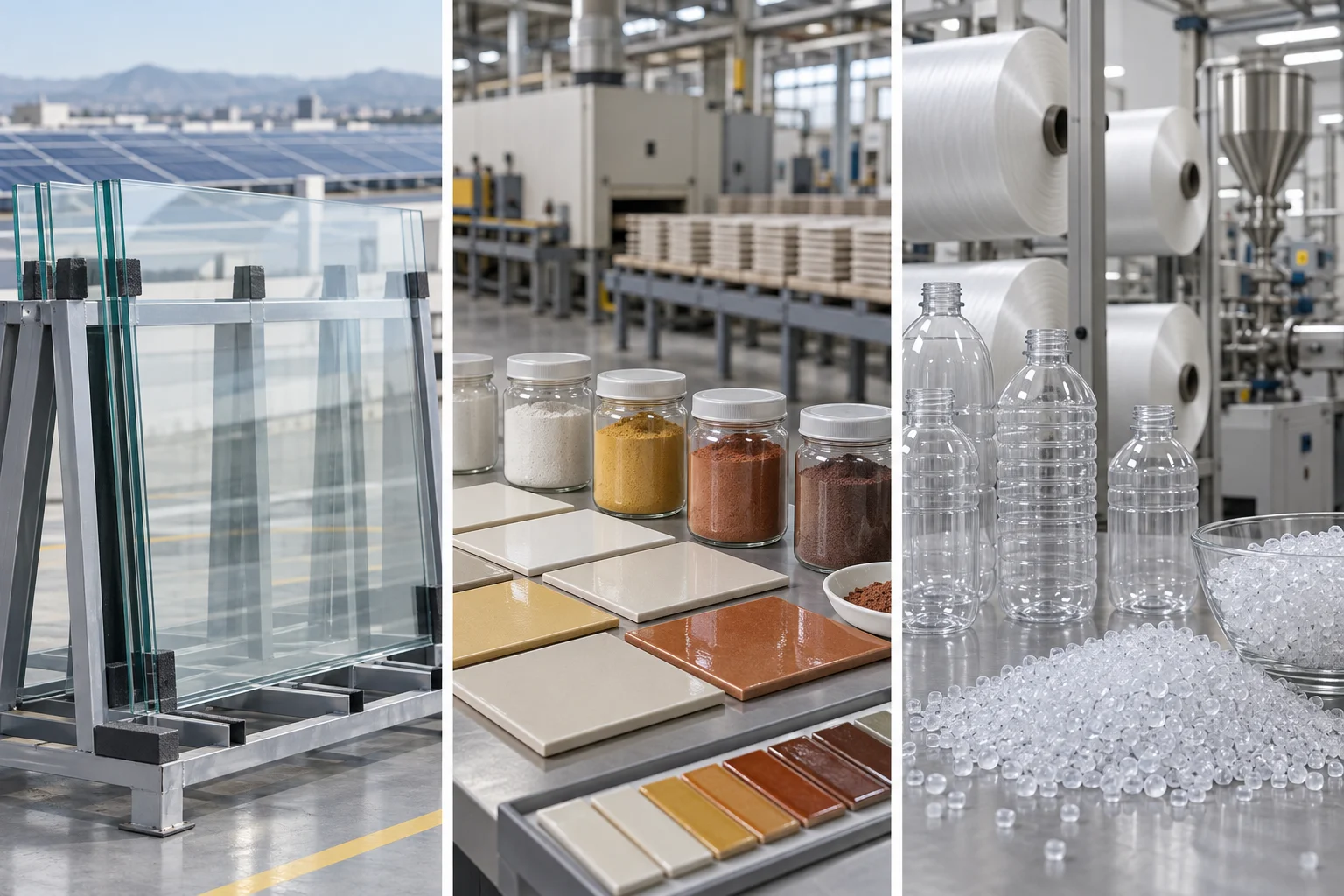
| Application | Material and role | Purchasing considerations |
|---|---|---|
| 04 Selected glass and solar cover glass | Antimony pentoxide or sodium antimonate in compatible glass-fining systems | Glass formulation, impurities, bubbles and optical-quality targets |
| 05 Ceramics, glazes and inorganic pigments | Antimony trioxide as a raw material for selected pigment and ceramic-colour systems | Purity, particle size, target colour and firing conditions |
| 06 PET bottles, films and polyester fibres | Antimony catalysts in polymerization, before forming or spinning the resin | Catalyst dissolution, process fit, polymer colour and finished-product specifications |
Sources: NYACOL solar-glass applications, Campine pigment feedstocks and antimony glycolate for polyester.
Use in PET means participation in the polymerization catalyst system, not direct addition of ingots to finished plastic. Use in solar glass does not mean every photovoltaic module uses an antimony-containing formulation.
C. Batteries, automotive brakes and industrial bearings
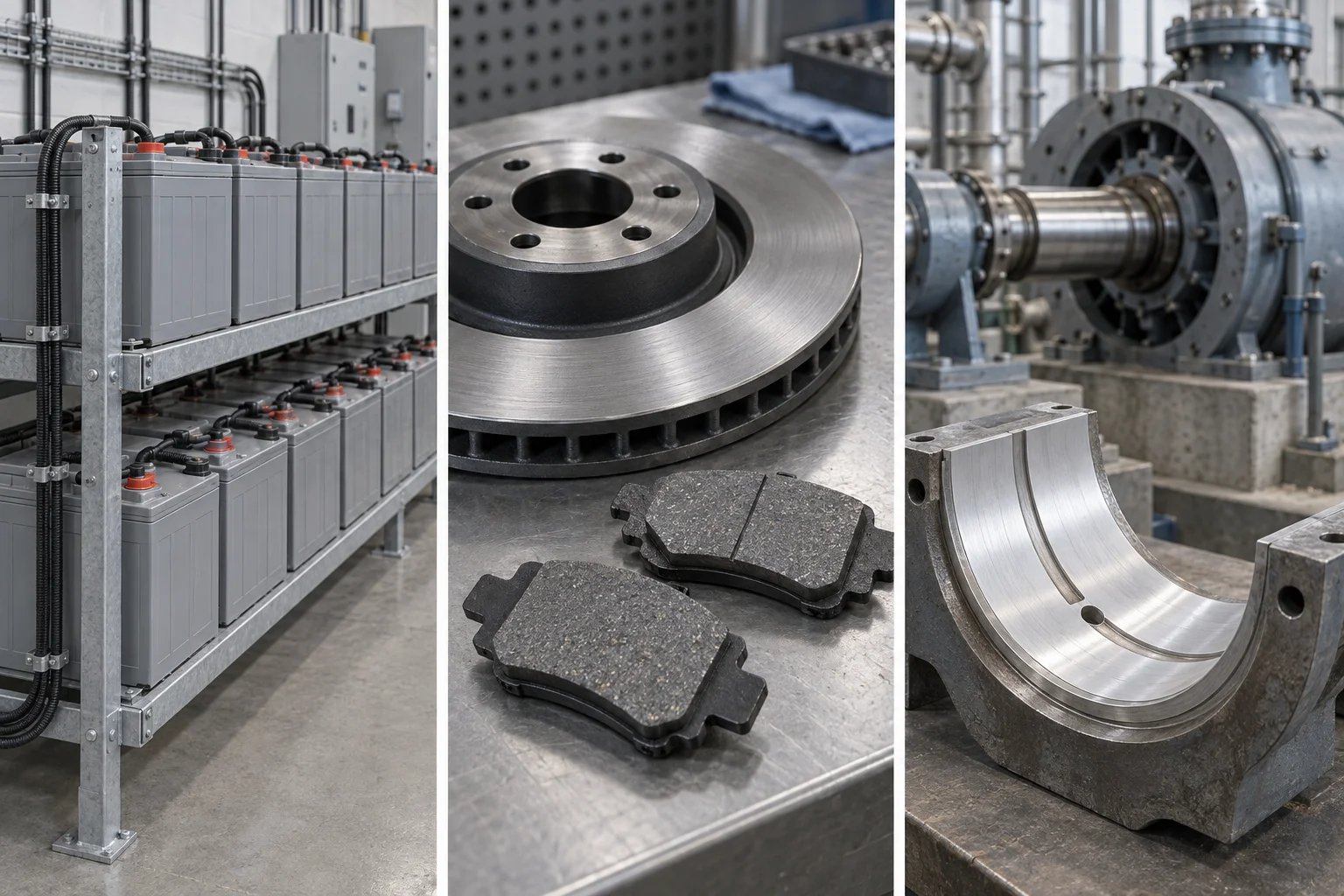
| Application | Material and role | Purchasing considerations |
|---|---|---|
| 07 Selected lead-acid batteries | Lead-antimony alloys in suitable grids and components | Alloy composition, impurities, casting process and battery design |
| 08 Automotive brake pads and shoes | Antimony trisulfide as a constituent in selected friction formulations | Purity, particle size and testing of the complete friction material |
| 09 Industrial plain bearings and shells | Tin-antimony-copper and other babbitt alloys in suitable white-metal linings | Alloy grade, lining requirements and operating conditions |
Sources: alloy uses from the Royal Society of Chemistry, Nihon Seiko friction-material information and Waukesha bearing materials.
Lead-acid batteries use different grid-alloy designs; not all use lead-antimony. Likewise, babbitt linings belong to particular plain-bearing designs, not all bearings.
D. Cables, functional coatings and infrared analysis
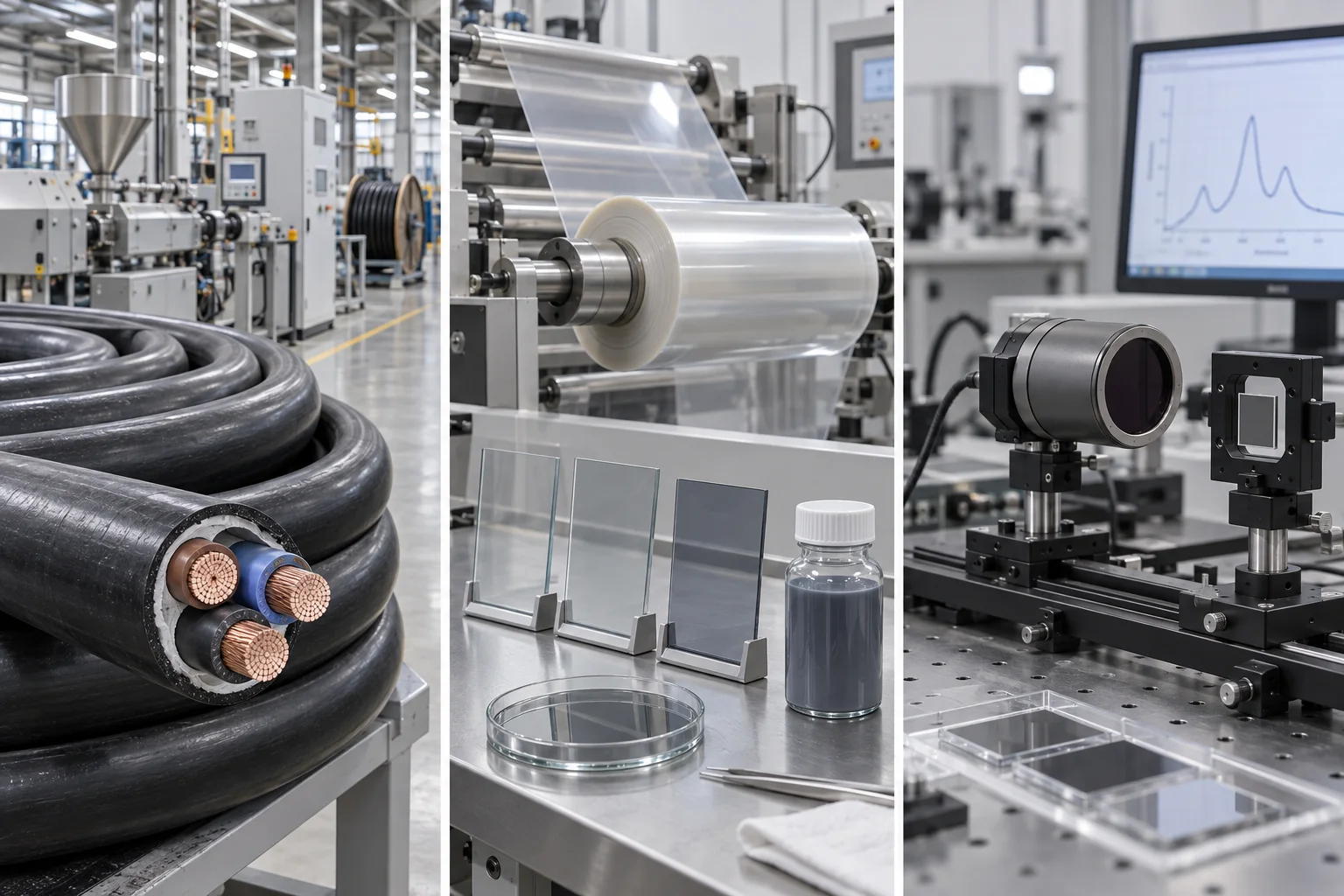
| Application | Material and role | Purchasing considerations |
|---|---|---|
| 10 Selected cable insulation and sheathing | Antimony trioxide or related formulated products in compatible flame-retardant systems | Polymer type, addition form, fire performance and other finished-product requirements |
| 11 Antistatic and infrared-absorbing coatings | Antimony-doped tin oxide powders or dispersions | Doping composition, dispersion medium, transmission, haze and electrical or optical targets |
| 12 Selected infrared detection and spectroscopy instruments | InSb, InAsSb and related semiconductor systems in suitable detectors | Device material, wavelength band, operating conditions and performance specifications |
Sources: Nihon Seiko cable-material applications, NYACOL doped tin oxide and Hamamatsu detector selection.
A broad range of uses does not make one antimony product suitable for every application. Establish whether the purchase is for ingots, compounds, formulated products or functional materials before agreeing on specifications. This industry overview does not mean RTV manufactures or supplies every listed product, nor does it identify RTV customer projects.
6. Grades and test reports: what buyers should check
A grade describes an agreed product class; a test report records results for particular samples; the contract sets acceptance requirements for the transaction. These must correspond.
RTV uses No. 2 antimony ingot (Sb99.65) as a reference grade in supply discussions. It is not a complete analysis of every batch or proof of suitability for any particular process. Confirm requirements against the purchasing specification, agreed standard and batch results. RTV antimony ingot information
| Check | Information to specify or verify |
|---|---|
| Main constituent | Required Sb content, analytical method and acceptance basis |
| Impurities | Limits for applicable elements such as As, Pb, Fe, Cu and S; additional tests for special uses |
| Batch identity | Heat numbers, package markings, quantity and report coverage |
| Sampling | Who samples, where, which goods are represented, sealing and retention |
| Delivery | Packaging, net-weight verification, handover point, title transfer and onward collection |
An SGS report alone does not establish that an entire cargo conforms. Verify the scope, sample origin and correspondence with the goods. Client-submitted samples and on-site sampling by the testing organisation may support different conclusions. SGS considers material characteristics and commercial requirements when planning metal sampling; one fixed sampling percentage cannot serve every ingot order. SGS mineral and metal sampling
See the antimony sampling and batch-verification guide for further preparation.
7. Purchasing antimony ingots through RTV
RTV is the exclusive sales agent for its partner antimony smelter in Laos; exclusivity is limited to that partner factory. RTV coordinates purchasing requirements, batch information and delivery arrangements. The partner factory performs the smelting. Agency roles
For No. 2 ingots, RTV's minimum purchase quantity is 25 metric tonnes. Buyers complete KYC verification and sign the contract one month in advance; the actual delivery date is agreed separately. Handover takes place through an in-warehouse transaction at the Laem Chabang bonded warehouse in Thailand. After taking delivery, the buyer arranges onward transport independently. Purchasing guide
For an initial inquiry, provide the company name, quantity, intended use, quality specification, desired handover date, third-party testing requirements and collection or transport plans. Price, available lots and delivery timing are confirmed for the actual transaction.
Frequently asked questions
Can ore directly replace ingots?
They are not interchangeable feedstocks. Ore contains other minerals and requires appropriate processing; ingots have already been smelted and refined. The buyer must assess suitability for its equipment and process.
Is antimony ingot the same as antimony trioxide?
No. Ingots are mainly metallic antimony, whereas antimony trioxide is the compound Sb₂O₃. Their specifications and uses differ.
Does Sb99.65 mean every downstream plant can use it?
No. Impurity limits and application requirements must also be checked. The grade alone does not determine the quality of the downstream product.
Can pictures prove purity or stock availability?
No. Pictures help describe appearance or packaging. Purity requires test results; stock and title require corresponding batch and warehouse records. The images in this article are AI illustrations, not evidence of available cargo.
Does RTV manufacture all the downstream products shown?
This article explains the antimony supply chain. RTV's role described here concerns ingot sales for its partner smelter; the downstream materials and applications shown do not define RTV's manufacturing or supply scope.