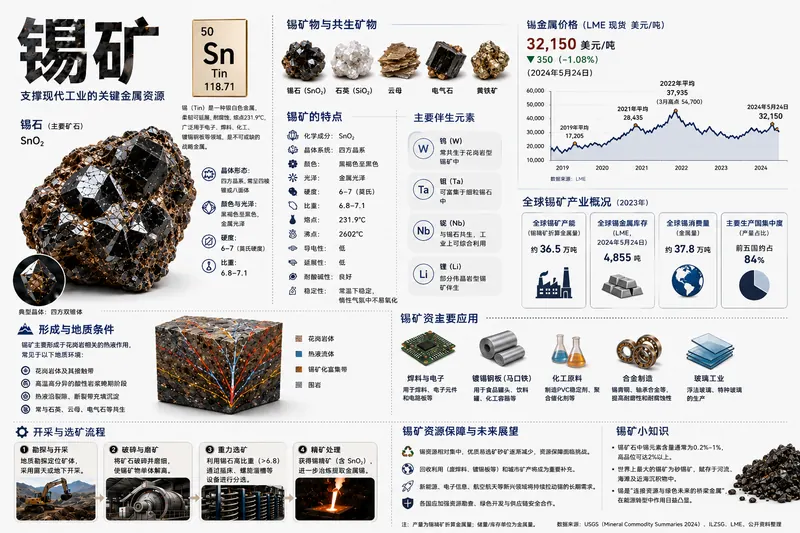
Tin ore mainly refers to cassiterite, with the chemical composition SnO2. It is the most important industrial tin mineral. After beneficiation, tin ore is usually traded as tin concentrate and then refined by smelters into tin metal for electronic solder, tinplate, tin chemicals, bronze alloys, photovoltaic ribbon and new-energy vehicle electronics.
Although tin is a minor metal by volume, it has clear strategic value in modern industry. For China-based smelters, traders and procurement teams, tin ore import work should not focus only on price and grade. It must also consider origin authenticity, assay results, customs declaration, logistics, payment terms and supply stability.
Tin ores and concentrates.
Declaration should follow the actual cargo, current customs requirements and batch documents.
Confirmed by assay certificate, retesting result and buyer specification.
Main uses of tin ore
The largest end use of tin is electronic solder, covering circuit boards, chip packaging, mobile devices, AI servers, automotive electronics and smart equipment. Tin demand is also influenced by semiconductors, photovoltaic modules, electric vehicles and industrial automation.
- Tinplate: food cans, beverage cans and packaging materials.
- Tin chemicals: PVC stabilizers and organotin compounds.
- Bronze alloys: bearings, mechanical parts and marine components.
- Photovoltaic solder ribbon: connection material for solar modules.
- New-energy vehicle electronics: PCB, control systems, sensors and intelligent components.
Major global tin ore origins
Global tin ore resources are concentrated in China, Indonesia, Myanmar, Peru, Bolivia, Brazil, Russia and Malaysia. China is both a major tin producer and the world's largest tin smelting and consumption market. Southeast Asian tin resources, particularly Myanmar tin ore, Indonesian tin supply and Malaysian tin resources, have a direct impact on China tin concentrate imports and international tin price trends.
From a trade perspective, procurement should not rely only on the country name. Buyers should verify mine authenticity, export qualification, grade stability, impurity levels, payment conditions, logistics route and China import compliance requirements.
Geological characteristics of tin ore
Tin ore is often related to granite hydrothermal activity. Tin-bearing fluids rise along fractures and precipitate to form primary tin deposits. Some primary ore is weathered, transported and enriched into alluvial tin ore.
- Primary tin ore: commonly related to granite, quartz veins and polymetallic ore belts.
- Alluvial tin ore: formed by weathering and transport in river, alluvial and coastal sediment zones.
- Associated tin ore: often occurs with tungsten, tantalum, niobium, iron, zinc and lead minerals.
Because cassiterite has a high specific gravity, beneficiation often uses gravity separation equipment such as shaking tables, spiral chutes, jigs and centrifugal concentrators.
China tin ore import and customs declaration requirements
China imports of tin ores and concentrates are generally classified under HS Code 2609000000, with the English commodity name Tin ores and concentrates. Final declaration should always follow current customs rules, contract documents and the actual batch.
Declaration elements may include brand type, export benefit status, processing method, composition content, mine name, signing date, pricing date, demurrage status, GTIN, CAS and other notes. In practice, buyers should also check clay, residue or non-mineral contamination, radioactive abnormality risk, solid waste classification risk and reasonable declared value.
Tin price, inventory and market judgment
Tin is a high-volatility minor metal. Key factors include LME tin price, LME tin inventory, Myanmar supply recovery, Indonesian refined tin export policy, China smelter procurement rhythm, and downstream demand from semiconductors, AI servers, photovoltaic modules and new-energy vehicles.
When LME inventory declines or Myanmar and Indonesian supply is constrained, tin price tends to be more sensitive to upside moves. When inventory recovers or consumption slows, price may consolidate or correct. Price judgment should combine LME, SMM, actual trades, batch grade and logistics cost; public webpage prices should not be treated as transaction basis.
Core competitiveness in tin ore trade
Tin ore trading is not a simple mineral purchase. It is a supply-chain process from origin verification, sampling, assay, grade confirmation, impurity control, logistics customs clearance and smelter delivery. For procurement teams, smelters and traders, stable origin, accurate testing, compliant documents, real logistics and reliable delivery are the core competitiveness.
This article is practical trade information and does not constitute a fixed quotation, fixed procurement quantity or binding transaction commitment. Grade, price, quantity, moisture, impurities, payment, customs clearance and delivery terms are subject to the actual lot, assay result, contract terms and applicable regulations.